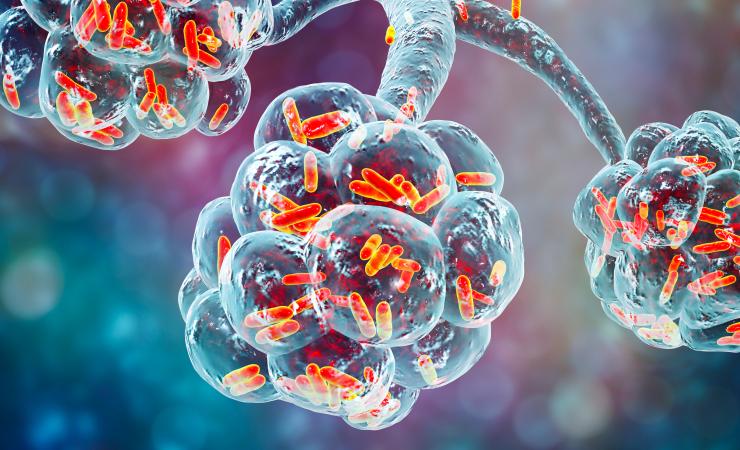
Pneumonia is one of the most common causes of death in the world, taking the lives of more than 808 000 children under the age of five in 2017.
The disease is usually treated with antibiotics, however drug-resistant pneumonia kills more than 400 000 people every year. New antibiotics are urgently needed, and COMBINE is working hard to help address this need.
The COMBINE project, which is part of the IMI AMR Accelerator programme, aims to standardise tools used for drug development and improve quality and consistency in preclinical studies. The project developed two important resources to help researchers develop effective antibiotics against drug-resistant pneumonia – a standardised, reproducible and well-characterised in vivo lung infection model and a preclinical bacterial strain repository featuring seven strains of well-characterised, virulent bacteria.
Standardised lung infection models
Before drugs are tested in humans, they must go through rigorous in vitro (cell-based models) and in vivo (animals models), preclinical studies. Regulators overseeing medicine development expect robust proof-of-concept and safety data before human trials can proceed, and animals like mice have long been used in medical research to help understand disease and assess the potential efficacy and safety of new treatments.
The protocols that researchers use to test drugs in mouse models often vary from laboratory to laboratory, and this makes reproducibility and comparisons of data difficult. COMBINE’s model and accompanying protocol are standardised, meaning that scientific results could be more rapidly translated into real-world medical treatments.
“Developing the COMBINE standard pneumonia model is a truly unique project, bringing together academia and industry with the aim of improving the reproducibility of a preclinical infection model,” says Jon Ulf Hansen, senior scientist at Statens Serum Institut, who led the development of the lung infection model.
“Using a standard model will eliminate much of the variability in experimental conditions, and increase the likelihood that results are comparable across labs. Further, using a standardised mouse model may speed up the process of generating proof of concept efficacy data.”
However, there are limitations of traditional animal-based testing including high costs, long durations and lack of predictivity. An advantage of the standardised mouse model developed by COMBINE is that it reduces the number of animals required in new studies, because there is lower biological and environmental variation, increasing the precision of experimental results and reducing the sample size needed. This is in line with the 3R principles: to reduce, refine and replace the number of animals needed for research and testing.
“Adopting our COMBINE pneumonia model and reference strains will reduce costs and efforts required for establishing their own models by investigators, which is also an important contributor to our shared goal of reducing animal use in research (3R),” says Bernhard Kerscher of the Paul-Ehrlich-Institut, who led the work on the Bacterial Strain Repository.
“By developing the harmonised COMBINE mouse pneumonia model and establishing a repository of qualified and carefully characterised Pseudomonas aeruginosa and Klebsiella pneumoniae strains, we’re giving researchers and antibiotics developers a solid foundation to test new molecules and benchmark them against existing reference treatments.”
Well-characterised virulent bacterial strains
COMBINE also developed a preclinical bacterial strain repository consisting of well-characterised and virulent strains of the Gram-negative bacteria Klebsiella pneumoniae and Pseudomonas aeruginosa, known as the IMI COMBINE Preclinical Bacterial Strain Repository. These strains act as references for preclinical efficacy studies and are available to researchers via the German Collection of Microorganisms and Cell Cultures and the Paul-Ehrlich-Institut’s reference materials site.
“Our work tackles a major obstacle in antibiotic development: the lack of reliable, standardised, and comparable infection models and antibiotics efficacy data,” says Bernhard Kerscher.
“By developing the harmonised COMBINE mouse pneumonia model and establishing a repository of qualified and carefully characterised Pseudomonas aeruginosa and Klebsiella pneumoniae strains, we’re giving researchers and antibiotics developers a solid foundation to test new molecules and benchmark them against existing reference treatments.”
Next steps
The new tools are already being taken up by the antibiotic research community.
“We’ve already seen the application of the COMBINE K. pneumoniae and P. aeruginosa strains in preclinical studies outside of this project,” says Hansen.
“We hope that defining easily implementable standard conditions for a mouse pneumonia model and making accessible bacterial strains that are performing consistently across laboratories will help researchers both when establishing new bacterial strains in the model and for benchmarking using the COMBINE strains.”
The COMBINE project is now using the model to define pharmacokinetic and pharmacodynamic parameters for specific antibiotics, work that is led by Uppsala University. While pharmacokinetic parameters define what the body does to a drug – i.e. how the drug is absorbed, metabolised and eliminated – pharmacodynamic parameters measure what the drug does to the body, for instance therapeutic and toxic effects. This is a vital step to optimise drug dosage, ensure therapeutic efficacy, avoid or minimise side effects, and reduce drug-resistant mutations.
“This work will further validate the reference strains and the standard protocol and can be used for benchmarking, thus having validated control groups across a novel antibiotic development programme,” says Hansen. “As the next step we are evaluating the translational value of the model comparing preclinical and clinical data.”
COMBINE is supported by the Innovative Medicines Initiative, a partnership between the European Union and the European pharmaceutical industry.