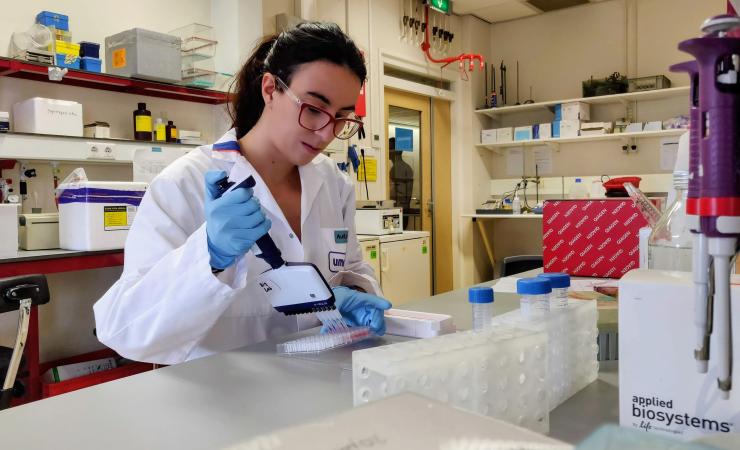
How did you become interested in this field of study and why were you attracted to the VAC2VAC project?
A year before I started the PhD, I had worked as a Masters student in the vaccinology lab of Anke Huckriede, as I was interested in virology. I wanted to do an internship in biology, specifically in the Netherlands, and I came across her lab. I was coming from Italy, and at the end of my internship, Professor Huckriede mentioned that she had a PhD project she was going to start, which was VAC2VAC. I liked it because I liked the 3Rs idea in general, I liked the idea that I could contribute to less animal suffering, less animal use in science.
What was your project about, within the context of the VAC2VAC project?
The project was about finding new methods of assessing the potency of the tick-borne encephalitis vaccine, because at the time it was assessed in animals, specifically in rabbits. To see if the vaccine was working, the rabbits would be vaccinated and then the virus would be delivered intracranially to the rabbits. Researchers would see whether the animals lived or died after they had been exposed to the virus when they had been vaccinated. It was a pretty rough way of measuring if the product was compliant. I had to find a new way, an animal-free way, to assess whether the vaccine that was produced was working.
What was the main challenge you encountered?
One problem was that when you give a vaccine to a human, it's usually a lot more diluted than the initial active ingredient that is made, and aluminium is also added to enhance the immune response. All of these things make it harder to measure in vitro, because the cells need more of the basic ingredients and they are sensitive to aluminium, they die from it.
I had to figure out not only what kind of immune responses you have to assess, but also what kind of material you have to test: not the final material that would be delivered to the market, but a more intermediate product. So during my PhD, I tried different types of cells, different types of concentration, different types of responses, different types of starting material. And at the end, we found one type of cell that will respond to a range of concentration of a certain type of intermediate products.
Does that mean that your in vitro test could replace the animal tests?
It’s not a one-to-one translation. The method that I worked on will be used as part of a range of tests to substitute the animal method. The idea is that you have a global picture of the products and you can make an assessment of whether that batch is good or not based on several methods.
How did the public-private elements of VAC2VAC help you with this project?
GSK was the company making the vaccine, so it was a collaboration with them. It was good to interact with industry because otherwise you don’t really come across that, and it’s good for later in your career. If you don’t want to stay in academia, it’s good to start speaking the language of industry. Working with a consortium like VAC2VAC, you encounter a large network of people, who I came across again and again during my career.
When you’re doing a PhD, you’re focusing on a really small area and going very in-depth. But as you move to a later stage of your career, the scope becomes a bit bigger. Gaining knowledge about the other VAC2VAC projects that I encountered at conferences, the sharing of knowledge, and of frustrations, with other researchers, is also very valuable.
What were the next steps in your career after your PhD?
The first few years of my career I continued to work in that area, in vaccine development and later biologics. My transition to industry was pretty smooth because I moved into a research and development unit, in a pharmaceutical company, but as close to research as it could be. It was also during COVID and I was working on the COVID vaccine, so that helped because it felt like what I was doing was needed. I’ve always been interested in developing new methods to test medical products using less animals. Later on, I went to work with the Dutch medicines agency where they assess what the pharmaceutical companies are doing.
Do you think that from working in the PPP you were more aware of regulatory affairs and regulatory processes than you might otherwise have been?
I knew a lot about the certain regulation regarding the part of the project that I was doing in my PhD, but it was very specific to that area. As time went on, I started speaking the same language as the regulators and that is appreciated because a lot of the time, people come out of academia and they don’t really have an idea of how things go in a pharmaceutical company or in a regulatory process. I had a general understanding of the steps that needed to be taken so that certainly helped.
What is the biggest challenge for the world of medicine production and regulation at the moment?
There has been a very rampant anti-vax feeling since the pandemic and that is still going on. And I think a part of it is that there is not a lot of knowledge of how pharmaceuticals are assessed, how vaccines work, how they are approved, what kind of efforts are being done.
There are a lot of checks and balances that are being done, by the public authorities, by the governments. In Europe, every batch of vaccine is always tested. This knowledge doesn't reach the public so easily and sometimes it doesn't even reach the scientific community.
It would be better if people knew how much things are carefully evaluated, especially in Europe. In general, with regards to pharmaceuticals and medicine, there is very little space for big errors.
A lot of time people don't know how these things work and that's our failure. We talk between each other, we talk about the regulatory process, but it's not really evident to the public how it goes. If people knew a bit better how medicines in general and vaccines are studied and evaluated and approved, and how many researchers, people in companies, people in the government are involved in this, then they would feel a bit less reluctant to take it and not jump to the conclusion that, because something is solved, there is a big conspiracy.
What advice do you have for somebody who is about to embark on a PhD?
Reach out as soon as possible to other people that are doing something similar to you. On your own, you won’t go very far and you won’t go very quickly either. What really helped my PhD was when we started collaborating with others working with the same products, they may have had different aims, but that sped things up. Dive into the material, study, but also reach out, talk to people, find out what works for them. Together you can probably find the solution quicker than you could on your own.
VAC-2-VAC is supported by the Innovative Medicines Initiative, a partnership between the European Union and the European pharmaceutical industry.