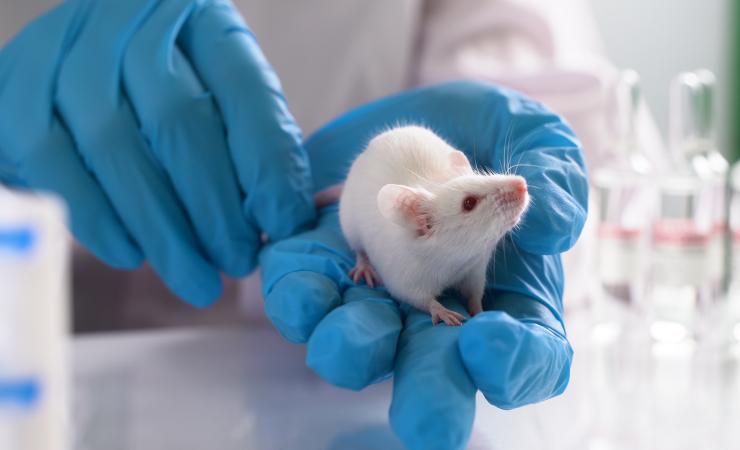
The World Day for Laboratory Animals shines a spotlight on the number of animals that are used for research and asks whether improvements can be made, to ensure safe scientific progress while respecting animal life and reducing deaths and suffering wherever possible. To that end, IHI and IMI projects are pursuing a range of approaches, from in vitro alternatives, to organoids, in silico and computer modelling, and more. We’ve selected four examples here below to demonstrate how our projects are making a difference.
Digital twins to replace animal controls
Before approving medicines for sale on the market, there are a series of stringent tests which must be carried out to determine whether they are safe to use. Important tests that evaluate whether a drug candidate has a negative effect on the body are the so-called repeat dose toxicity studies which involve animals such as rats, mice or dogs.
When testing a drug on a group of animals, there must be another group of animals from the same population that are living in exactly the same conditions as the animals being treated, with only one difference: they are not receiving the test material that’s being investigated. This concurrent control group is necessary to compare results – it ensures that the researchers can safely conclude that any effect seen in the treated animals is because of the drug that is being tested, and not because of any other variable. These groups significantly contribute to the total number of animals used in experiments.
Companies tend to guard data on tested animals – it is sensitive data that they often do not want their competitors to have access to. But data on control groups is different. No drug candidate has been administered to the control group, meaning that the data is valuable without containing trade secrets.
Within the IMI eTOX and eTRANSAFE projects, data was gathered to generate predictive models of toxicity for new compounds. From those databases, VICT3R extracted control group data to develop virtual control groups (VCGs), a digital twin of concurrent control groups. Using this historical toxicology data, VCGs could replace part or all the control animals in a study, sparing roughly 4000 rats per year from preclinical studies in the EU.
VICT3R then carried out robust tests to ensure that the virtual control groups perform exactly as a ‘live’ control group would.
“Ideally you would not see any difference between the concurrent controls of live animals and the virtual controls, and VICT3R is showing that there are no significant differences affecting the outcome of the safety studies,” says Thomas Steger-Hartmann of Bayer, who is the industry lead of VICT3R.
“We are doing toxicity studies because we want to protect patients, consumers and the environment from harm. Therefore if we change anything in the design of these studies, we need to ensure that nothing is impaired.”
The project identified a wide range of historical data on rats that can be searched so that researchers can find individuals that match their needs (such as weight, age, vehicle of administration) to build their virtual control group.
To prove that the digital twins can reliably imitate live control groups, VICT3R carried out a robust retrospective analysis on a number of studies that showed that when the virtual control groups were substituted for concurrent control groups, the overall study outcomes remained the same.
This information was then submitted to the European Medicines Agency (EMA) for the qualification of a new approach methodology (NAM) using virtual control groups instead of standard (concurrent) control groups in rat non-GLP dose-range finding (DRF) studies. The EMA has now published a draft qualification opinion on the approach which is open for public consultation.
The qualification of virtual control groups marks a crucial first step towards reducing animal use in medicines safety testing, and it could create a blueprint for future applications.
“This qualification that we are reaching for is serving the whole NAMs community because we are paving the way for future more ambitious approaches,” says Ferran Sanz of the Universitat Pompeu Fabra, academic lead and project coordinator of VICT3R.
Eliminating unnecessary rabbit pyrogen tests
Before a new batch of medicines can be released for use, manufacturers must run certain tests to check that the batch is safe for patients, whether human or animal. The tests required to assess the safety and quality of different types of medicines are set out in a reference work called the European Pharmacopoeia.
In the case of medicines administered by injection, such as vaccines, some antibiotics, and blood products, manufacturers have to test for pyrogens, contaminants which can trigger a fever. For decades, the rabbit pyrogen test (RPT) has been the most common pyrogen test, and some 400 000 rabbits worldwide were subjected to the test every year.
VAC2VAC focused on the monocyte activation test (MAT), a cell-based assay for pyrogens. The project validated the MAT for testing batches of ENCEPUR, a vaccine against tick-borne encephalitis virus (TBEV) and it was approved by the competent authorities in Germany, allowing the vaccine manufacturer, GSK, to start implementing the method.
VAC2VAC’s work helped to convince the European Pharmacopoeia Commission (EPC) to eliminate the RPT from its monographs entirely. Since 2025, the RPT is no longer required and medicines developers can instead select a suitable in vitro test, such as the MAT, to test their products for pyrogens.
Reducing the use of fish tests for environmental risk assessments
Since 2006, all new medicines for human use have to undergo environmental risk assessments. This is because after medicines pass through the body, some components can reach the environment. Active pharmaceutical ingredients of medicines and their metabolites may pass through sewage systems and out into the world, where they could cause harm. New medicines must demonstrate, by a series of stringent tests, including one test with fish, that they are not harmful.
Environmental risk assessments for “old” medicines (authorised before 2006) are not yet required, but it is expected that they will soon be regulated for.
That means that fish tests will need to be conducted for potential environmentally harmful “old” medicines . The question that PREMIER asked was, is it ethical to order fish tests for medicines that have already been on the market for many years when we already have a lot of data about these products that could be used to determine environmental impact instead?
The 3Rs principle is a policy goal to replace animals in research where possible, reduce the numbers of animals used in research, or refine procedures to minimise suffering.
In accordance with the 3Rs, the PREMIER project developed a robust and conservative decision tree to evaluate when fish tests are needed to evaluate the environmental risk that a legacy medicine poses, or when an alternative could work instead. The tool is conservative, favouring a clean bill of environmental health over reducing fish numbers, but even so the researchers estimate that it can reduce the number of fish needed by 30%. To date, more than 100 pharmaceuticals have been run through the decision tree to evaluate its suitability.
“We looked at the available data and we saw that for many pharmaceuticals there is very negligible risk. That’s because either the concentrations in the environment are very low or the toxicity is very low, especially to fish, or both. For many of these cases it’s clear that a fish test is not necessary to come to that conclusion,” says Anja Coors, managing director of ECT Oekotoxikologie GmbH, who was the lead researcher on developing the decision tree.
The decision tree is backed up by an in silico model which predicts the concentrations of pharmaceutical compounds that can pass from the water into fish’s bodies. It does this using human data from clinical tests – the idea is that if humans don’t experience toxicity to certain concentrations of these compounds being present in the blood, then it is unlikely that these compounds would cause fish problems at the same concentrations in their blood. To be on the safe side, the model also puts a safety factor of 1000 on top.
“If the concentrations are 1000 times below the safe human plasma concentrations then it is unlikely that the fish are going to suffer at a population level from this medication,” says Coors.
The decision tree and the in silico model will help to maximise animal welfare without causing harm to the environment, and PREMIER is investigating whether the tool can be improved to reduce fish testing even further. Altogether, the fish test decision tree is about finding a better balance between environmental protection and animal welfare considerations.
“We are revisiting the fish test decision tree with the work that we are now doing in PREMIER, there are new in vitro tests and more data available that we will run through to see if we come to the same results,” says Coors.
Replacing animal research with human stem cells in a dish
Induced pluripotent stem cells involve taking a sample from a patient, usually from a very easily accessible part of the body such as skin or blood cells, and these cells can be genetically reprogrammed to take them back to a pluripotent state, meaning an early developmental stage where a stem cell can differentiate into any cell type.
Once in a pluripotent state, these cells can then be directed to form a cell type of any part of the body. They can also be used long-term – theoretically they can be stored forever, meaning that there is an endlessly renewing set of cells to work from.
Unlike embryonic stem cells, induced pluripotent stem cells are derived from skin or blood cells taken from a study volunteer who has gone through an informed consent process, meaning that there are no ethical or legal concerns with regards to use of the data.
The EBiSC project developed a bank of these cells where researchers can assess these cell lines. To date, EBiSC has 1000 iPSC lines collected from 25+ different organisations across the EU and the USA (and accepts lines from any country worldwide), and EBiSC cells have been distributed to 30 countries across 4 continents since 2016.
The big advantage of EBiSC is that it is far easier for researchers to access the bank and request the cell lines that they need, rather than try to develop their own induced pluripotent stem cells. What’s more, the researchers using EBiSC can trust that the same standardised procedures have been applied to all EBiSC cell lines and that the cell lines are of a high quality. In this way, EBiSC speeds up research, boosts the reproducibility and comparability of results and ensures that researchers have access to a high quality bank of cell lines to work from.
“Somebody can come to EBISC and access iPSC lines under one agreement. They know that those lines have been banked under the same core protocols and that they've all gone through the same panel of quality control and that they've been checked for ethical and legal provenance, ensuring that those ethical and legal aspects are all covered,” says Rachel Steeg, head of EBiSC at Fraunhofer UK Research Ltd.
Using induced pluripotent stem cells for research reduces the number of animals being used in scientific research, as there are many cases where testing on human cells may be more beneficial or relevant than using animal models. A lot of exploratory science for instance, may not require animals if stem cells could be used instead.
“If you want to know more about Alzheimer’s disease, obviously you can’t go to a patient and ask for a sample of their brain tissue,” Steeg explains. “Previously in these cases we would have used animal models. But an animal isn't a human, and the way that animals display disease is sometimes completely different to how a human would. We can collect a blood or skin sample from a patient with Alzheimer's disease and reprogram it to an iPSC. We take that iPSC line, differentiate it to different types of neurons, and create a model of Alzheimer’s disease in a dish that we can then study to look at the progression and the pathology of the disease. Of course, these models have limitations and are still developing, but they are quite often much more representative than an animal model.”
Large panels of iPSCs can also be created to mimic populational variability and understand how, for instance, many different risk factors impact disease onset. This is also a huge advantage over animal models, Steeg explained.
“Looking at one or two genetic models [for this kind of research question] is never going to find a good solution. But what you can do with iPSCs is create a large panel covering lots of different variabilities,” she says.
EBiSC is now a self-sustaining iPSC biobank and researchers can deposit iPSC lines and access iPSCs here.