The Innovative Health Initiative has launched two open calls to date, looking for big-picture ideas that address our scientific research objectives. Unlike other calls, call 9 and call 12 did not point to a specific challenge to address, but instead asked applicants to pose their own solutions to the healthcare challenges outlined in IHI’s strategic agenda.
The three academic hospitals that originally came up with the idea for the Hospital At Home project pitched at IHI’s brokerage event and went on to build a strong public-private consortium that ultimately was funded under call 9. We spoke to three researchers from the project about their experiences and how they formed their partnership.
Where did the idea for Hospital@Home come from?
The idea for Hospital@Home sprang from three university hospitals: Erasmus UMC in the Netherlands, Aarhus University Hospital in Denmark, and Karolinska University Hospital in Sweden. They had set up a learning community under the European University Hospital Alliance to share experiences and learn from each other, and realised that they were facing the same challenges.
“Within this learning community, we discussed the concept of Hospital@Home a lot. The call from IHI was a gift from heaven to see if we could collaborate with industry partners to roll out the plan,” says Linetta Koppert, surgical oncologist and clinical epidemiologist at Erasmus UMC, who is the project coordinator of Hospital@Home.
Hospital@Home is the type of project that epitomises what IHI is all about. The consortium includes not only a mix of public and private partners, but also a mix of industries, involving the pharmaceutical industry, the medtech industry, the medical imaging industry and the biotech industry. Patient organisations, SMEs, digital and AI experts, regions as well as academic hospitals all play their part in the partnership.
Why apply for IHI funding, why was Hospital@Home best suited to a public-private partnership?
Hospital@Home’s aim is to create a model where patients can receive personalised, hospital-level treatment at home, thanks to intelligent, connected digital systems and devices that ensure the safety, quality and continuity of care.
“The goals of IHI align very closely with what we want to achieve with Hospital@Home, that is developing practical, innovative solutions for real healthcare challenges,” says Lihui Pu, a registered nurse and health researcher from Erasmus UMC. She was the person who originally spotted IHI’s call 9, and alerted the other academic hospitals to the opportunity that it presented. “The partnership model allows us to work with a wide range of stakeholders, which is essential for making real impact.”
Koppert had already been involved in public-private partnerships before, including IMI’s H2O project. She had had a positive experience working in a collaborative project and told the other hospitals that the IHI funding would be worth applying for.
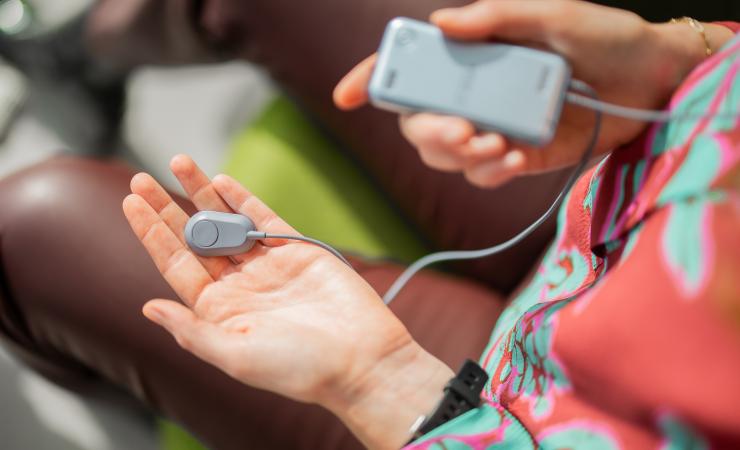
For Daniel Schobben, founder and chief innovation officer of Salvia Bioelectronics, Hospital@Home presented an opportunity to gain insights from the hospitals that would help them to make their products better in the future as well as tackling common problems that hampered their progress. Salvia Bioelectronics focuses on novel therapies for resistant migraines, using ultra-thin implants that target key nerves. It’s activated by pressing a button on a wearable device, making it a good fit for the Hospital@Home project.
“For us it’s a great way to get insight into how the hospitals are working now, what they are struggling with and how we can make our products and services better for the future, so that they are supporting the clinical workflows there as well,” he says. “We can only benefit from all the insights that we get out of the Hospital@Home project.”
Another advantage is that the consortium will tackle some common problems that Salvia Bioelectronics and the other medtech and pharma companies have, like for instance the storage of digital data.
“We have five indications [as part of Hospital@Home], which are heart, lung, stroke, migraine, and cluster headache. The needs in those use cases are different, but overall, you always have the same questions. You need to store patient data that is anonymised in a safe way in the cloud. There needs to be a patient app where patients can give feedback on how are they doing, et cetera, so there are a lot of parallels there,” he says.
Hospital@Home pitched at IHI’s brokerage event. Tell us about that experience.
Pu pitched the idea for Hospital@Home during IHI’s brokerage event in 2024, and the idea piqued the interest of several event attendees who went on to become partners in the project.
“It was a very valuable experience, the pitching session went very well. We had the chance to present our project, meet potential partners, and start building strong collaborations. After the presentation, many people approached us, both during and after the event, and showed strong interest in the project,” she says.
“We booked meeting rooms and had several face-to-face discussions with potential partners. This was very helpful and well organised, making it easy to have focused conversations. It was also a great environment for exchanging ideas.”
According to Schobben, the conversations after the pitching session were crucial in kick-starting the consortium.
“My guess would be that probably if the brokerage event had not been there, maybe the project would not be there,” he said. “After the pitching session, those conversations built momentum. The brokerage event made all the difference in being the spark for the development of the project.”
Schobben also attended and pitched at IHI’s call 12 brokerage event in 2025 and said it was a “wonderful event”.
“When I went on stage, I didn't know how it would go. I said, I’ve reserved this room on the first floor at 1:15, and the room was full. I went there first, just by myself, about five minutes early and then there were fourteen or fifteen people already there from all disciplines. People who were interested in health economics, in patient record systems, outcome measures, new therapies, it was very exciting. There were also many that came to me via the online platform. I had a lot of email conversations and this allowed us later on to be able to pull in more parties that could complement the consortium.”
Hospital@Home has a broad consortium, covering universities, hospitals, pharma, medtech, biotech, SMEs, patient organisations – how hard was it to find these partners?
“It was quite challenging,” remembers Pu. “We needed partners who not only shared our vision but were also willing to contribute resources, including in-kind contributions. Meeting the required contribution levels (45%) takes time and effort, so building the right consortium required a lot of networking and discussions. The most important take-away from the brokerage event was to set up the connections and networks, and then build up the consortium through these networks. The online platform was also useful for sharing our project idea and connecting with potential partners.”
How did you find applying for an applicant-driven call as opposed to a traditional call format?
While appreciating the need for top-down calls to address certain strategic objectives, Koppert, Pu and Schobben highlight the value of an open call.
“Compared to traditional calls, this approach allows for more creative and diverse ideas, often with stronger real-world relevance,” says Pu. “It also makes it easier to build a consortium that truly fits the project.”
“I think in this way, you have a much more level playing field where the best proposals can win rather than the ones that happened to fit in a certain bucket, so I really welcome this,” says Schobben.
“I learned that you have to have the idea written down, lying on your desk, waiting for the call to come!” says Koppert. “It's always better than seeing a call and thinking how you can target it.”
Any advice for future potential applicants?
“My first advice would be to team up with the right stakeholders from the beginning. I think that's very, very important,” says Koppert. “Have strong leadership, come forward with timelines, things that you expect to do. We had the blessings of a really good project management team.”
For Pu, maximising the opportunities presented by networking events made all the difference.
“I strongly recommend joining a brokerage event because it’s a great way to present your idea and meet partners,” she says. “Make sure your idea clearly fits the call topic, use the online platform early to share your idea and connect with others, plan meetings in advance during the event, follow up with interested partners afterwards and build up networks. These steps could help researchers build a strong consortium.”
Schobben agrees with both of the above points but also highlights the need to allow time for larger organisations’ lengthy approval channels.
“When developing the proposal, timelines are always underestimated, especially due to decision-making processes in larger organisations. Small and medium enterprises are able to decide within days to join and to provide certain materials. Large organisations sometimes have two, three or even four layers of authorisation to be allowed to join. Check with your new potential partners so that they are aware early on what is involved,” he advises.