The impact of IHI and IMI health research funding is measured in several ways, and one of those is scientific excellence. To measure scientific excellence is not easy, but one method is by examining the impact and influence of peer-reviewed scientific publications developed by projects.
Every year, IHI commissions the production of a bibliometric report to evaluate the performance of our research outputs. The latest report, covering papers published from 2010 to 2025, has now been published, and it is clear from its findings that IHI and IMI research continues to be highly influential.
In scientific publishing, researchers refer to other influential scientific literature to make arguments, to demonstrate the relevance of their research or to refer to other pieces of related work in their field. These are called citations, and measuring citations is a clear way to demonstrate the impact that a paper has had on the scientific world.
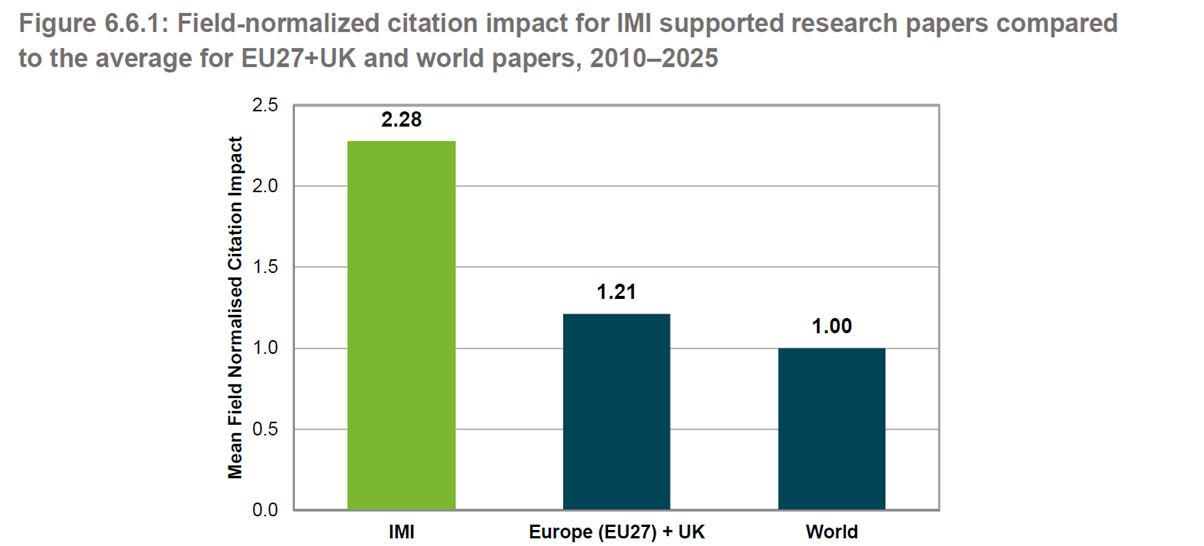
Here, IMI punches well above its weight - almost a third of IMI papers are in the top 10% of most cited papers worldwide, and IMI papers exceed the citation impact of research from 27 EU countries and the United Kingdom by 88%.
The IHI programme started to launch calls in 2022, and several projects are still in the early stages of research, which is why the publication record for IHI is not as advanced as IMI’s.
Despite that, IHI JU publications are already demonstrating their influence, with a citation impact more than double that of European publications and 63% greater than that of Horizon Europe.
The value of collaborative research
The vast majority of IHI and IMI scientific publications is the result of collaborative research. Our projects blend the forward-thinking of academic research with the practical needs and expert know-how of industry partners, while also bringing SMEs, patients, regulators and other important actors to the table.
That partnership mindset can be clearly seen in the publication record – cross-stakeholder collaborations are present in 86% of IHI’s published papers and cross-country collaborations in almost 80% of IHI papers.
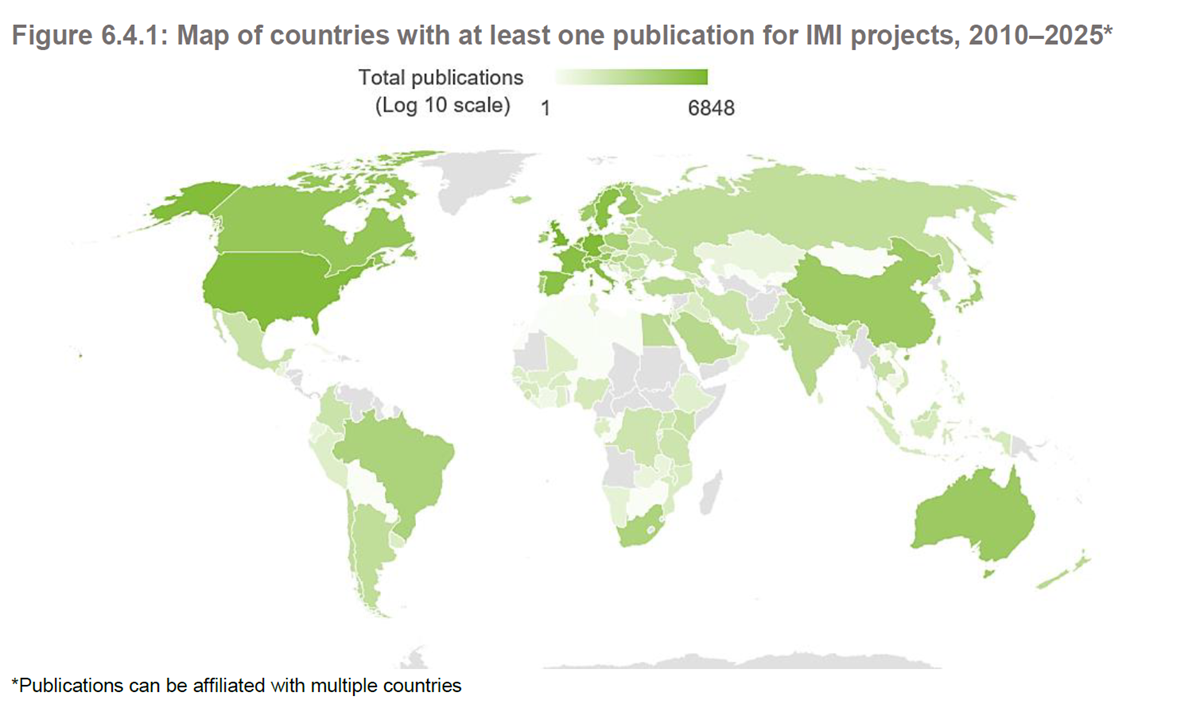
Collaboration between countries is also clear – 80% of IHI papers feature international collaboration spanning 62 countries, and 20 countries now have ten or more IHI funded research publications. IMI collaborative research involves countries all over the globe. 135 countries have at least one paper funded by IMI and there are 77 countries which have ten or more IMI funded publications.
The figures show that bringing together diverse perspectives delivers results – IHI-funded papers with more than five countries represented record citation rates that are more than four times the world average. In a similar vein, the collaborative research carried out by IMI-funded project yields a higher level of citation impact than the IMI average. This indicates that collaborative, multi-stakeholder research is having a greater influence than research that is conducted by either single sector, single-institution or single-country publications.
IMI ahead of the competition
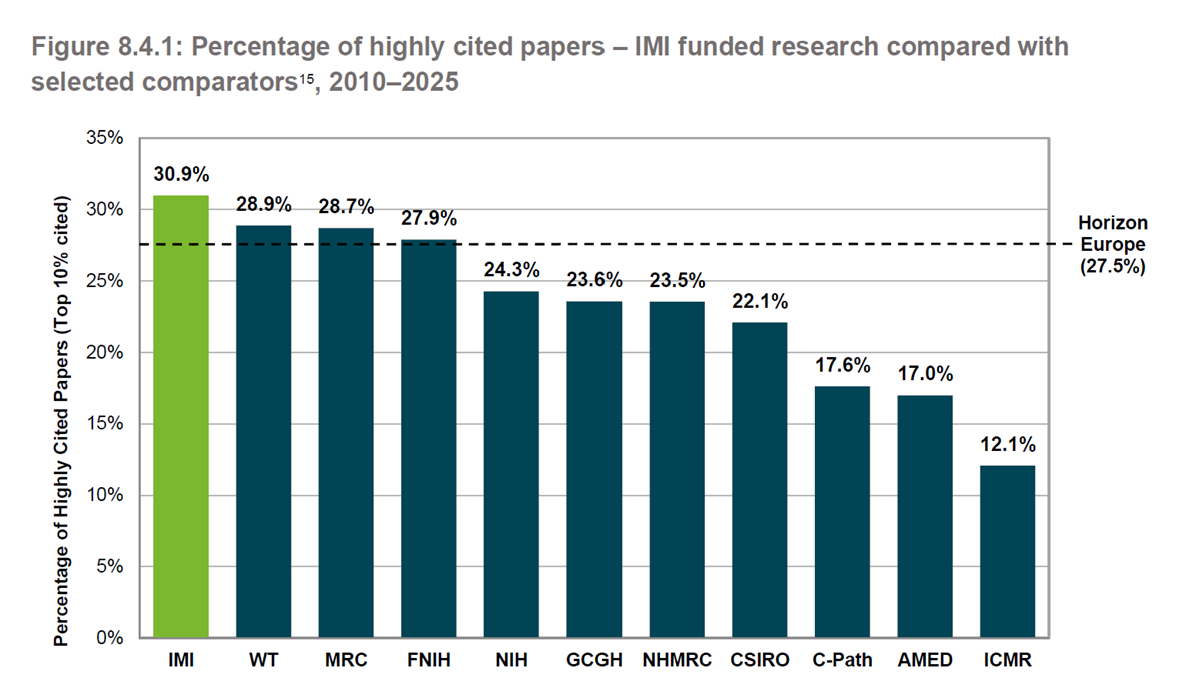
A greater percentage (30%) of IMI-funded research publications are highly cited compared to the percentage of highly-cited publications produced by other health research funding programmes such as the Wellcome Trust, Medical Research Council (UK), Foundation for the National Institutes of Health (US), National Institutes of Health (US), Global Grand Challenges in Global Health, National Health and Medical Research Council (Australia), the Japan Agency for Medical Research and Development, Critical Path Institute, Commonwealth Scientific and Industrial Research Organisation (CSIRO), Indian Council of Medical Research. IMI also performs well compared to the percentage of Horizon Europe publications that are highly cited (30% vs 27.5%).
The report shines a light on the high-quality and high value of IHI and IMI scientific outputs.
“This track record demonstrates that scientific excellence is consistently being produced by IHI and IMI public-private partnerships,” says Niklas Blomberg, IHI’s executive director.
“The proportion of high-quality papers arising from our projects, and the high citation impact of those publications, make it clear that IMI and IHI’s formula reaps rewards – that bold collaborations result in impactful scientific results that can progress health research further and drive solutions for patients.”
Niklas Blomberg, executive director of IHI