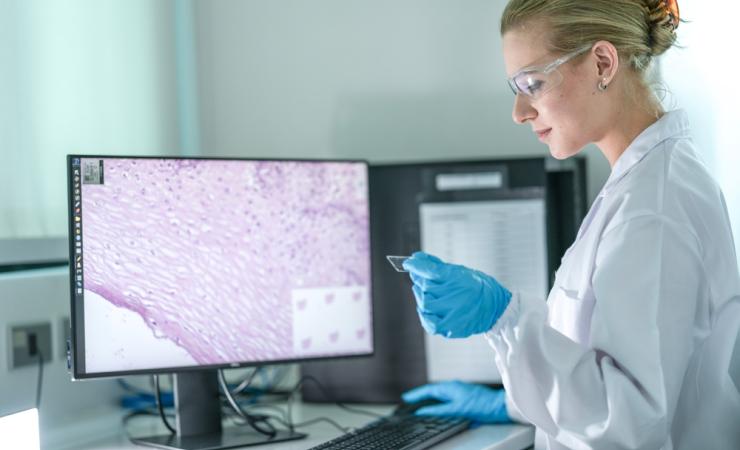
Data has become the currency of science today, and projects like Bigpicture and VICT3R are making strides to ensure that efficient use and management of historical data, coupled with advanced statistics and AI techniques, can enhance healthcare for patients.
Whole slide analysis is an essential part of pathology, the branch of science that diagnoses disease by examining surgically removed parts of tissue. Pathologists are trained to look for specific indicators of disease in order to make a diagnosis, allowing the doctor in charge of the patient to then decide what treatment – if any – is required. They also help to identify and interpret the adverse effects of novel drugs on the organs and tissues of laboratory animals to test drug safety and efficacy before going to human trials. But there are not enough pathologists to deal with the demand. If part of the assessment could be automated without any detriment to the quality of the results, it could dramatically speed up the process while decreasing the workload on pathologists and cutting costs.
Slide by slide, Bigpicture is digitising whole slide images and building the infrastructure needed to store, share and process millions of image files. The project hopes to create digital copies of around 3 million slides covering a range of disease areas.
VICT3R is tackling another issue – leveraging data to reduce the number of animals needed in preclinical research. The idea is to develop digital twins from existing data to replace the live animals that are currently used as control groups. Control groups account for around 25% of the animals used in drug and chemical safety studies, so replacing them with virtual animals would have a significant impact on the numbers of animals used.
By pulling swathes of control data from a wide range of studies, VICT3R’s virtual control groups should accurately indicate how different species of animals would behave if exposed to certain drugs, with the ultimate goal of replacing the animal control groups used in toxicity studies.
Two pieces of the same puzzle
For a long time, Bigpicture and VICT3R were doing their own thing, separately. But the projects soon realised that they could help each other out, to the extent that a Memorandum of Understanding was signed between the two projects on 28 May 2026.
Some of the control data that VICT3R is processing has whole slide image data attached, but VICT3R does not have the IT infrastructure needed to deal with it. Building this IT infrastructure would be a time-consuming and costly process. But these whole slide image data are precious, as there are likely to be scenarios where a pathologist may want to view the original slides that were prepared from the live animal tissue. For example, a pathologist may be needed to review unexpected findings, to confirm pathology findings or to look beyond the diagnosis. Reviewing the original slides can provide important context that is not always captured in summary tables or coded data. VICT3R realised that collaborating with Bigpicture would unlock access to whole slide image data in a more efficient way.
“There are overlapping data, meaning that the control and animal data that we have in VICT3R have corresponding slides in Bigpicture. We are currently exploring how we could build up a feasibility study where pathologists could go back and reread the whole slide images. This collaboration allows us to approach this topic,” says Thomas Steger-Hartmann of Bayer, the industry lead of VICT3R.
For Bigpicture, understanding how their massive library of digitised whole slides could be used by researchers moving forwards is a vital step forwards. Working with VICT3R enables them to trouble-shoot their offering and identify opportunities and gaps, so that the repository will be more useful to future users going forwards and ultimately have more impact.
Collaboration to accelerate progress
The collaborative approach avoids duplication and can rapidly accelerate the results of both projects.
For VICT3R, Bigpicture is a fully validated source of digital pathology data that can boost the usefulness of their virtual control groups. For Bigpicture, VICT3R is a ready-made, perfect test-bed to see what works and what doesn’t, and explore whether their data is organised in a way that makes sense for this use case.
“For Bigpicture it’s important that we have clear usage patterns and this is clearly one of them. There’s a need to make all these slide images available for multiple purposes,” says Rick van Nuland of Lygature, senior partnership leader in the Bigpicture project.
He points out that working with VICT3R on preclinical and non-sensitive animal control data can lead the way towards building complex data structures for future use with either human clinical data, or more sensitive company data.
“For research purposes, you want to use multi-modal data. If we can manage to have, from the same patient, data living in multiple repositories that can be combined, that would be of great value for the research community. However this is very complicated in terms of data privacy. You can look at the collaboration with VICT3R like a much easier pilot to demonstrate what we’ll do for the clinical data in the long run,” he says.
“A more fundamental challenge is not the technical infrastructure itself, but how to combine data from multiple sources in a trustworthy way without disclosing where individual data originate,” he continues. Technical safeguards are an important part of this, but they only partially address the broader need for governance, trust, and data-use models that allow sensitive information to be linked and analysed responsibly.
One important technical issue is that Bigpicture organises contributed data as study-based datasets, whereas VICT3R needs to construct virtual control groups by combining control data across multiple studies. A system must be devised to link and use data across repositories without exposing the origin of individual records or compromising sensitive information. The collaboration therefore highlights not only the need to adapt infrastructure, but also the need to establish trusted frameworks for combining distributed data in a scientifically robust and secure way.
Providing the framework for partnership
The connection between the two projects goes back to the IMI2 eTRANSAFE project. During eTRANSAFE some of the first ideas behind virtual control groups, which later became the basis for the VICT3R project, started to take shape. BigPicture was also presented at eTRANSAFE consortium meetings, giving many future VICT3R partners an early opportunity to learn about the initiative and its work.
Over the years, several organisations became involved in both projects, creating natural links between the two communities.
For Bigpicture, the collaboration between the two projects shows how public-private partnerships can extend the value of research infrastructures beyond their original scope.
“The regulatory acceptance of virtual control groups and the adoption of AI in pathology require alignment across industry, academia, and regulators. Public-private partnerships create the neutral, trusted environment needed to combine data, expertise, and resources across these groups, making collaborations such as Bigpicture and VICT3R both possible and impactful,” says Anna-Lena Frisk, scientific director of pathology at The Janssen Pharmaceutical Companies of Johnson & Johnson, and deputy project lead for Bigpicture.
For VICT3R, the structure of the public-private partnership helped to make this alliance a reality.
“The public-private partnership creates a natural environment for projects working on related challenges to find each other, exchange ideas, and explore common interests. It brings together industry, academia, SMEs, regulatory experts, and other stakeholders who would not necessarily interact so closely otherwise. This type of collaborations make the projects more productive and efficient by generating synergies and avoiding duplication of efforts,” says Inari Soininen, senior project manager of Synapse Research Management Partners, which leads VICT3R's work on dissemination and sustainability.
“The IHI framework is an important enabler for this type of collaboration. It provides more than funding by creating a common environment where projects working towards similar goals can get to know each other, exchange ideas, and identify areas of mutual interest. In many cases, projects also share partners, which helps build connections and trust from the start," she explains.
"This makes it much easier to understand each other's work, find opportunities to collaborate, and build on each other's strengths. Without that shared framework, it would be much less likely that the right people would come together at the right time to explore these opportunities.”
BigPicture is supported by the Innovative Medicines Initiative, a partnership between the European Union and the European pharmaceutical industry; whereas VICT3R is funded by the Innovative Health Initiative.